


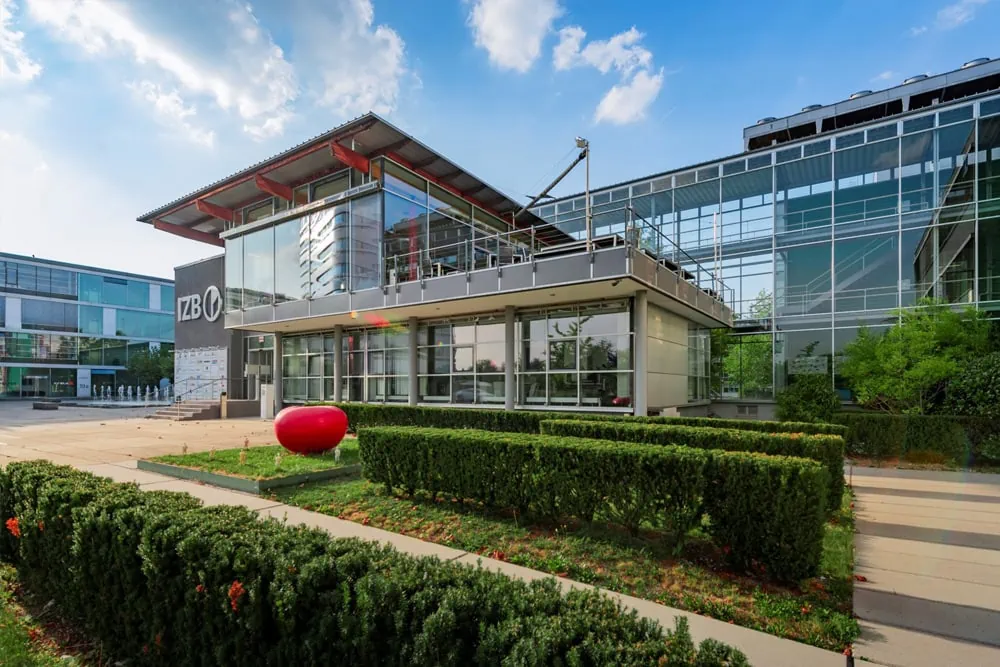
Innovations- und Gründerzentrum Biotechnologie in Martinsried bei München
Innovation and Start-up Center Biotechnology in Martinsried by Munich
Martinsried bei München, 31. Januar 2023 – Das Innovations- und Gründerzentrum Biotechnologie (IZB), eines der führenden Biotechnologiezentren in Europa mit fast 50 ansässigen Biotech Start-ups, blickt auf ein erfolgreiches Jahr 2022 zurück. „Wir sind stolz auf die unglaubliche Dynamik am Biotech-Standort München. Im zweiten Halbjahr 2022 konnten wir gleich vier neue Unternehmen im IZB begrüßen, was unser Netzwerk aus erstklassigen Wissenschaftlern und Branchenexperten weiter bereichert und den interdisziplinären Austausch zusätzlich beflügelt“, sagt Dr. Peter Hanns Zobel, Geschäftsführer des Innovations- und Gründerzentrums Biotechnologie. „Die Start-ups bei uns im IZB arbeiten daran, bahnbrechende Technologien zu entwickeln und auf den Markt zu bringen. Besonders freut mich, dass diese Spitzenforschung auf enormes Interesse bei Life-Science-Investoren stößt, die die Unternehmen im Jahr 2022 mit Finanzierungen von gut 220 Mio. Euro unterstützt haben.“
Gelungenes zweites Halbjahr bei Finanzierungen von IZB-Start-ups
Nach einem sehr erfolgreichen ersten Halbjahr 2022 mit Finanzierungen von über 170 Mio. Euro sicherten sich die Entrepreneure im IZB auch im zweiten Halbjahr wichtige Deals in Höhe von 52,5 Mio. Euro. (1)
Im Oktober gab adivo, ein führendes Unternehmen in der Erforschung speziesspezifischer therapeutischer Antikörper für Haustiere, einen Zuschuss des European Innovation Council (EIC) Accelerator in Höhe von 2,5 Mio. Euro bekannt. Die Förderung wird zur Beschleunigung der Entwicklung des firmeneigenen Antikörperprogramms verwendet, das den wachsenden Bedarf an neuartigen Therapieoptionen für Hunde mit entzündlichen Darmerkrankungen adressiert.
CatalYm, ein Pionier für GDF-15-Targeting in der Immunonkologie, hat im November den Abschluss einer Serie-C-Finanzierungsrunde in Höhe von 50 Mio. Euro abgeschlossen. Die Runde wurde von den neuen Investoren Brandon Capital und Jeito Capital angeführt, unter Beteiligung der bestehenden Investoren Forbion, Novartis Venture Fund, Vesalius Biocapital III, Bayern Kapital, BioGeneration Ventures und Coparion. Die Finanzierung soll die weitere klinische Entwicklung des Hauptkandidaten Visugromab voranbringen. Der monoklonale Antikörper wird momentan in einer Phase II-Studie bei Patienten mit soliden Tumoren untersucht.
Darüber hinaus sicherte sich IZB-Alumnus Immunic Therapeutics (Nasdaq: IMUX), ein biopharmazeutisches Unternehmen mit einer Pipeline von selektiven, oral verfügbaren Immunologie-Therapien zur Behandlung chronischer Entzündungs- und Autoimmunerkrankungen, im Oktober 2022 eine sogenannte PIPE-Finanzierung (private investment in public equity) in Höhe von 60 Mio. US-Dollar (ca. 55,7 Mio. Euro). Die Finanzierung wurde von einem Konsortium neuer und bestehender institutioneller Investoren gezeichnet und soll die laufende klinische Entwicklung der drei führenden Produktkandidaten des Unternehmens sichern.
Attraktiver Standort – nicht nur für Start-ups
Im zweiten Halbjahr 2022 konnte das IZB einige neue Unternehmen auf dem Campus begrüßen. So eröffneten im Oktober gleich zwei Unternehmen Büros im Gründerzentrum. Das Life-Sciences-Team von VC-Investor Andera Partners hat damit nun neben Paris einen weiteren Standort. Das internationale Team ist seit dem Jahr 2000 aktiv und verfügt über umfangreiche Erfahrungen im Bereich Private Equity und Risikokapital. Bisher hat es über seine BioDiscovery-Fondsfamilie mehr als 1,1 Mrd. Euro aufgebracht und in mehr als 75 europäische und US-amerikanische Biotech- und Medtech-Unternehmen investiert.
Des Weiteren eröffnete auch das nordeuropäische Beratungsunternehmen KLIFO ein Satellitenbüro im IZB, um auch physisch näher an seinen Kunden zu sein. KLIFO bietet strategische Beratung und operative Dienstleistungen in allen Bereichen der Arzneimittel- und Medizinproduktentwicklung und verfügt über 25 Jahre Erfahrung in der Zusammenarbeit mit internationalen Unternehmen aus der Biotech-, Pharma- und Medizintechnikindustrie.
Mit Atriva Therapeutics zog im November ein weiteres Unternehmen ins IZB. Atriva verfolgt einen neuartigen Ansatz bei der Bekämpfung von bekannten und neu auftretenden viralen Infektionskrankheiten der Atemwege wie COVID-19 und Influenza, bei denen nicht das Virus, sondern vielmehr Wirtszellproteine als Angriffspunkte für die Therapie genutzt werden. Das Hauptprodukt von Atriva, Zapnometinib (ATR-002), ist ein first-in-class Wirkstoff, der in Signalwege in der Wirtszelle eingreift und so die Virusreplikation hemmt und die Immunreaktion des Körpers auf RNA-Viren günstig beeinflusst. Atriva hat weitere Standorte in Tübingen und Frankfurt am Main.
Kurz vor Jahresende konnte das IZB mit T-CURX noch ein Start-up begrüßen. Die Biotech-Ausgründung der Universität Würzburg entwickelt personalisierte Immuntherapien auf Basis von CAR-T Zellen der nächsten Generation für Krebsindikationen mit hohem medizinischen Bedarf. Im Mittelpunkt der CAR-T-Technologien von T-CURX steht eine neuartige Sleeping Beauty (SB) Transposon-Gentransfertechnologie, für welche das Start-up die exklusiven Lizenzrechte besitzt. Der Hauptsitz des Unternehmens ist im Innovations- und Gründerzentrum Würzburg.
Mit AMSilk, einem weltweit führenden Anbieter von innovativen, biobasierten Hochleistungsseidenmaterialien, ist 2022 auch ein Unternehmen dem IZB entwachsen. Mit dem Umzug in speziell angefertigte, größere Büroräume auf dem kürzlich errichteten Campus Neuried in München leitete AMSilk im Oktober die nächste Etappe auf seinem Weg ein, biotechnologisch hergestellte Seidenmaterialien weltweit anzubieten. Mit mehr als 2.000 m2 sind die neuen Büroräume dreimal so groß wie der bisherige Sitz am IZB und unterstützen die nächste Entwicklungsphase des Unternehmens, das die Produktion innerhalb der nächsten drei bis fünf Jahre auf mehrere tausend Tonnen pro Jahr steigern will.
Strategische Investments und neue Forschungskooperationen
Insempra (ehemals Origin.Bio), ein biologiegestütztes Unternehmen, das es Unternehmen ermöglicht, in Partnerschaft mit der Natur überlegene Produkte herzustellen, hat im Juli die Gründung von Solena Materials mit einem strategischen Investment unterstützt. Das Start-up, eine Ausgründung des Imperial College London, entwickelt synthetische Proteine für Hochleistungs-Bekleidungsfasern. Solena wird ein wichtiger Bestandteil der Plattform von Insempra sein, um leistungsstarke, von Natur aus nachhaltige Inhaltsstoffe für eine breite Palette von Branchen zu liefern.
Ebenfalls im Juli gab adivo die Erweiterung einer globalen Forschungskooperation mit einem führenden Unternehmen für Tiermedizin bekannt. Die bestehende Kooperation zur Behandlung schwerer Krankheiten bei Hunden wurde durch die Vereinbarung um die gemeinsame Forschung und Entwicklung von therapeutischen monoklonalen Antikörpern für Katzen erweitert. Gleichzeitig erfolgte die Markteinführung von adivos neuartiger katzen-spezifischer Antikörperbibliothek FELIX, der ersten vollsynthetischen Quelle für therapeutische Antikörper auf dem Markt. Der Partner wird Forschungsprojekte auf Basis von FELIX durchführen, wofür adivo Forschungsgelder, erfolgsabhängige Meilensteine und Tantiemen auf vermarktete Produkte erhält.
Das Biotechnologieunternehmen Eisbach Bio ist Mitglied im Nukleinsäurechemie-Cluster C-NATM, das zu den sieben Gewinnern des vom Bundesministerium für Bildung und Forschung (BMBF) geförderten Wettbewerbs Clusters4Future gehört. Das C-NATM-Netzwerk hat sich zum Ziel gesetzt, hoch innovative Therapeutika auf Nukleinsäurebasis für die Onkologie zu entwickeln. Zusammen mit Roche hat sich Eisbach verpflichtet, das Netzwerk über einen Zeitraum von mindestens drei Jahren mit seiner Forschungs- und Entwicklungsexpertise zu unterstützen.
Wichtige klinische Fortschritte und regulatorische Meilensteine
Die Unternehmen im IZB forschen an innovativen Wirkstoffen und Therapien gegen schwere, noch unheilbare Krankheiten bei Menschen und Tieren.
Im September veröffentliche CatalYm ermutigende Daten zur klinischen Wirksamkeit und Verträglichkeit seines GDF-Inhibitors zur klinischen Wirksamkeit und Verträglichkeit seines GDF-Inhibitors auf dem Onkologie-Kongress ESMO 2022. In der first-in-human Phase I-Studie wurden Tumorpatienten, die alle vorherigen Therapieoptionen ausgeschöpft hatten, mit dem GDF-15-neutralisierenden Antikörper Visugromab in Kombination mit einer Anti-PD-1-Therapie behandelt. Derzeit läuft eine Phase II-Studie mit Visugromab in verschiedenen Tumorindikationen, um die klinische Wirksamkeit sowie die Sicherheit, Pharmakokinetik und Pharmakodynamik weiter zu untersuchen, einschließlich umfassender Biomarker-Bewertungen.
Das am weitesten fortgeschrittene firmeneigene Onkologie-Programm von adivo erhielt im Dezember die eingeschränkte Marktzulassung von der Europäischen Arzneimittelagentur (EMA). Der Krebsantikörper für Hunde, der auf adivos CAESAR-Plattform basiert, könnte nun von einem beschleunigten Zulassungsverfahren in einem spezifischen Onkologie-Subsegment profitieren.
IZB-Events
Bei der 15. Biotech Press Lounge am 30. September 2022 kamen Multiplikator:innen aus der Biotech-, Pharma- und Venture Capital-Branche sowie Wissenschaftler:innen und Journalist:innen im IZB zusammen, um sich über den „Cocktail für den medizinischen Fortschritt“ auszutauschen. Über 60 Gäste verfolgten die drei inspirierenden Impulsvorträge, die zu intensivem Networking anregten.
Im Oktober fand der 7. Life Science Pitch Day im IZB statt, bei dem elf Biotech Start-ups und Projektteams ihre innovativen Ideen vor knapp 30 renommierten Life Science Investor:innen und Entscheidungsträger:innen aus der Industrie präsentierten. Die Partner High-Tech Gründerfonds (HTGF), Bayer AG, Boehringer Ingelheim und MEDICE waren begeistert von den starken Pitches der Gründer:innen und dem Potenzial der präsentierenden Start-ups.
(1) Die Finanzierung des Alumni Immunic fließt nicht in das Volumen der IZB-Deals ein.
Über das Innovations- und Gründerzentrum für Biotechnologie (IZB)
Die 1995 gegründete Fördergesellschaft IZB mbH betreibt das Innovations- und Gründerzentrum für Biotechnologie (IZB) mit den Standorten in Planegg-Martinsried und Freising-Weihenstephan. Das IZB zählt zu den führenden Biotechnologiezentren Europas. Auf 26.000 m2 sind derzeit mehr als 40 Biotech-Unternehmen und Life-Science-Firmen mit über 700 Mitarbeitern ansässig. Hier wird an der Entwicklung von Medikamenten gegen schwerste Krankheiten wie Krebs, Alzheimer und verschiedene Autoimmunkrankheiten gearbeitet. Ein wesentliches Kriterium für den Erfolg der IZBs ist die räumliche Nähe zur Spitzenforschung auf dem Campus Martinsried/Großhadern und dem Campus Weihenstephan. Auch die Infrastrukturmaßnahmen wie der Faculty Club G2B (Gateway to Biotech), das Hotel CAMPUS AT HOME, der Kindergarten Bio Kids sowie die Restaurants SEVEN AND MORE und THE BOWL Food Lounge sind Standortfaktoren, die von den Unternehmensgründern sehr geschätzt werden. Erfolgreiche Unternehmen, die aus dem IZB hervorgegangen sind, sind u. a. adivo (heute Zoetis), Corimmun (heute Janssen-Cilag), Crelux (heute Wuxi AppTec), Exosome Diagnostics (gekauft von Bio-Techne), ibidi, Immunic Therapeutics, Medigene, Micromet (heute Amgen), MorphoSys (bald Novartis), Octopharma oder Rigontec (heute MSD) sowie SIRION Biotech (heute Perkin Elmer). Weitere Informationen unter www.izb-online.de.
Pressekontakt sowie Bildmaterialanfragen:
Marion Köhler
Leitung Presse- und Öffentlichkeitsarbeit
Fördergesellschaft IZB mbH,
Innovations- und Gründerzentrum Biotechnologie
Am Klopferspitz 19
D-82152 Planegg-Martinsried
Telefon: +49 (0)89/55 279 48-17
E-Mail: koehler@izb-online.de
Website: www.izb-online.de
Martinsried near Munich, 31. January 2023 – The Innovation and Start-Up Center for Biotechnology (IZB), one of the leading biotechnology centers in Europe with almost 50 resident biotech start-ups, looks back on a successful 2022. “We are proud of the unbelievable dynamism at the biotech location in Munich. In the second half of 2022 alone, we welcomed four new companies to the IZB, which further enriches our network of first-class scientists and industry experts and also inspires interdisciplinary exchange,” says Dr. Peter Hanns Zobel, Managing Director of the Innovation and Start-Up Center for Biotechnology. “The start-ups here at the IZB work on developing groundbreaking technologies and bringing them to market. I am particularly pleased that this cutting-edge research is met with enormous interest from life science investors, who supported the companies with financing of a good 220 million EUR in 2022.”
Successful second half of the year for financing IZB start-ups
After a very successful first half of 2022 with financing of over 170 million EUR, the entrepreneurs at the IZB also secured important deals worth 52.5 million EUR in the second half of the year. (1)
In October, adivo, a leader in research into species-specific therapeutic antibodies for pets, announced a 2.5 million EUR grant from the European Innovation Council (EIC) Accelerator. The funding will be used to accelerate the development of the company’s inhouse antibody program, which addresses the growing need for novel therapeutic options for dogs with inflammatory bowel disease.
CatalYm, a pioneer in GDF-15 targeting in immuno-oncology, closed a 50 million EUR Series C funding round in November. The round was led by new investors Brandon Capital and Jeito Capital, together with the existing investors Forbion, Novartis Venture Fund, Vesalius Biocapital III, Bayern Kapital, BioGeneration Ventures and Coparion. The funding is intended to advance further clinical development of the lead candidate Visugromab. This monoclonal antibody is currently being investigated in a phase II study in patients with solid tumors.
In addition, ex-IZB start-up Immunic Therapeutics (Nasdaq: IMUX), a biopharmaceutical company with a pipeline of selective, orally administered immunology therapies for treating chronic inflammatory and autoimmune diseases, secured private investment in public equity (PIPE) funding in October 2022 amounting to 60 million US dollars (approx. 55.7 million EUR). The financing was underwritten by a consortium of new and existing institutional investors and is intended to support the ongoing clinical development of the company’s three lead product candidates.
Attractive location – not only for start-ups
In the second half of 2022, the IZB welcomed several new companies to the campus. In October, two companies opened offices at the start-up center. The life sciences team of VC investor Andera Partners thus now has another location in addition to Paris. The international team has been active since 2000 and has extensive experience in the field of private equity and venture capital. To date, it has raised more than 1.1 billion EUR through its BioDiscovery family of funds and invested in more than 75 European and US biotech and meditech companies.
In addition, the Northern European consulting company KLIFO opened a satellite office at the IZB in order to be physically closer to its customers. KLIFO offers strategic consulting and operational services in all areas of drug and medical device development and has over 25 years of experience in working with international companies in the biotech, pharmaceutical and medical device industries.
Another company, Atriva Therapeutics, moved to the IZB in November. Atriva is pursuing a novel approach in the fight against known and emerging viral respiratory infections such as COVID-19 and influenza, where host cell proteins rather than the virus are used as targets for therapy. Atriva’s lead product, Zapnometinib (ATR-002), is a first-in-class active agent that interferes with host cell signaling pathways to inhibit viral replication and beneficially influence the body’s immune response to RNA viruses. Atriva has other locations in Tübingen and Frankfurt am Main.
Shortly before the end of the year, the IZB welcomed another start-up, T-CURX. The biotech spin-off from the University of Würzburg develops personalized immunotherapies based on next-generation CAR-T cells for cancer diseases with a high unmet medical need. At the heart of T-CURX’s CAR-T technologies is a novel Sleeping Beauty (SB) transposon gene transfer technology, for which the start-up owns the exclusive licensing rights. The company’s headquarters are in the Innovation and Start-up Center in Würzburg.
In 2022, AMSilk, a leading global supplier of innovative, bio-based high-performance silk materials, joined the list of companies that have outgrown the IZB. In October, AMSilk moved to purpose-built, larger offices at the recently constructed Neuried campus in Munich to embark on the next stage in its journey towards offering bio-engineered silk materials globally. With more than 2,000 m2, the new work space is three times the size of the previous headquarters at the IZB, and supports the company’s next development phase, which aims to increase production to several thousand tonnes per year within the next three to five years.
Strategic investments and new research collaborations
Insempra (formerly Origin.Bio), a biology-powered company that enables companies to create superior products in partnership with nature, made a strategic investment in July to support the founding of Solena Materials. This start-up, a spin-off from Imperial College London, develops synthetic proteins for high-performance clothing fibers. Solena will be an important part of Insempra’s platform to deliver high-performance, intrinsically sustainable ingredients to a wide range of industries.
Also in July, adivo announced the expansion of a global research collaboration with a leading veterinary medicine company. The existing cooperation for treating serious diseases in dogs was extended by the agreement to include the joint research and development of therapeutic monoclonal antibodies for cats. At the same time, adivo launched its novel cat-specific antibody library FELIX, the first fully synthetic source of therapeutic antibodies available on the market. The partner will carry out research projects based on FELIX, for which adivo will receive research funds, success-related milestones and royalties on marketed products.
The biotechnology company Eisbach Bio is a member of the nucleic acid chemistry cluster C-NATM, which is one of the seven winners of the Clusters4Future competition sponsored by the Federal Ministry of Education and Research (BMBF). The C-NATM network’s aim is to develop highly innovative nucleic acid-based therapeutics for oncology. Together with Roche, Eisbach has committed to supporting the network for a period of at least three years with its research and development expertise.
Important clinical advances and regulatory milestones
The companies at the IZB are researching innovative active agents and therapies for serious, as yet incurable diseases in humans and animals.
In September, CatalYm released encouraging data on the clinical efficacy and tolerability of its GDF inhibitor at the oncology congress ESMO 2022. In the first-in-human phase I study, tumor patients who had not responded to all previous therapy options were treated with the GDF-15-neutralizing antibody Visugromab in combination with anti-PD-1 therapy. Currently, a phase II study of Visugromab in various tumor indications is ongoing to further evaluate its clinical efficacy, as well as safety, pharmacokinetics and pharmacodynamics, including a comprehensive assessment of biomarkers.
In December, adivo’s most advanced proprietary oncology program received restricted marketing approval from the European Medicines Agency (EMA). The canine cancer antibody, based on adivo’s CAESAR platform, can now benefit from an accelerated approval process in a specific oncology sub-segment.
IZB events
At the 15th Biotech Press Lounge on September 30, multipliers from the biotech, pharmaceutical and venture capital sectors as well as scientists and journalists came together at the IZB to discuss the “cocktail for medical progress”. More than 60 guests followed the three inspiring keynote speeches, which encouraged intensive networking.
In October, the 7th Life Science Pitch Day took place at the IZB, where eleven biotech start-ups and project teams presented their innovative ideas to almost 30 renowned life science investors and decision-makers from industry. The partners High-Tech Gründerfonds (HTGF), Bayer AG, Boehringer Ingelheim and MEDICE were impressed by the strong pitches made by the founders and the potential of the start-ups presented.
(1) Alumni Immunic funding is not included in the volume of IZB deals.
About the Innovation and Start-up Center for Biotechnology (IZB) in Martinsried near Munich
The Fördergesellschaft IZB mbH, founded in 1995, operates the Innovation and Start-up Center for Biotechnology (IZB) with sites in Planegg-Martinsried and Freising-Weihenstephan. The IZB is one of the leading biotechnology centers in Europe. More than 40 biotech and life science companies with over 700 employees are currently located on 26,000 square metres. Here, work is being done on developing drugs for the most serious diseases, such as cancer, Alzheimer’s, and various autoimmune diseases. A key criterion for the success of the IZBs is the physical proximity to cutting-edge research on the Martinsried/Grosshadern campus and the Weihenstephan campus. The infrastructure measures, such as the Faculty Club G2B (Gateway to Biotech), the hotel CAMPUS AT HOME, the kindergarten Bio Kids as well as the restaurants SEVEN AND MORE and THE BOWL Food Lounge, are also location factors that are highly valued by the founders of the companies. Successful companies that emerged from the IZB include adivo (now Zoetis), Corimmun (today Janssen-Cilag), Crelux (today Wuxi AppTec), Exosome Diagnostics (bought by Bio-Techn), ibidi, Immunic Therapeutics, Medigene, Micromet (today Amgen), MorphoSys (soon Novartis), Octopharma or Rigontec (now MSD) as well as SIRION Biotech (today Perkin Elmer). More information at www.izb-online.de.
Press contact and photo material requests:
Marion Köhler, Head of Public Relations
Fördergesellschaft IZB mbH,
Innovations- und Gründerzentrum Biotechnologie
Am Klopferspitz 19
D-82152 Planegg-Martinsried
Phone: +49 (0)89/55 279 48-17
E-Mail: koehler@izb-online.de
Website: www.izb-online.de

