


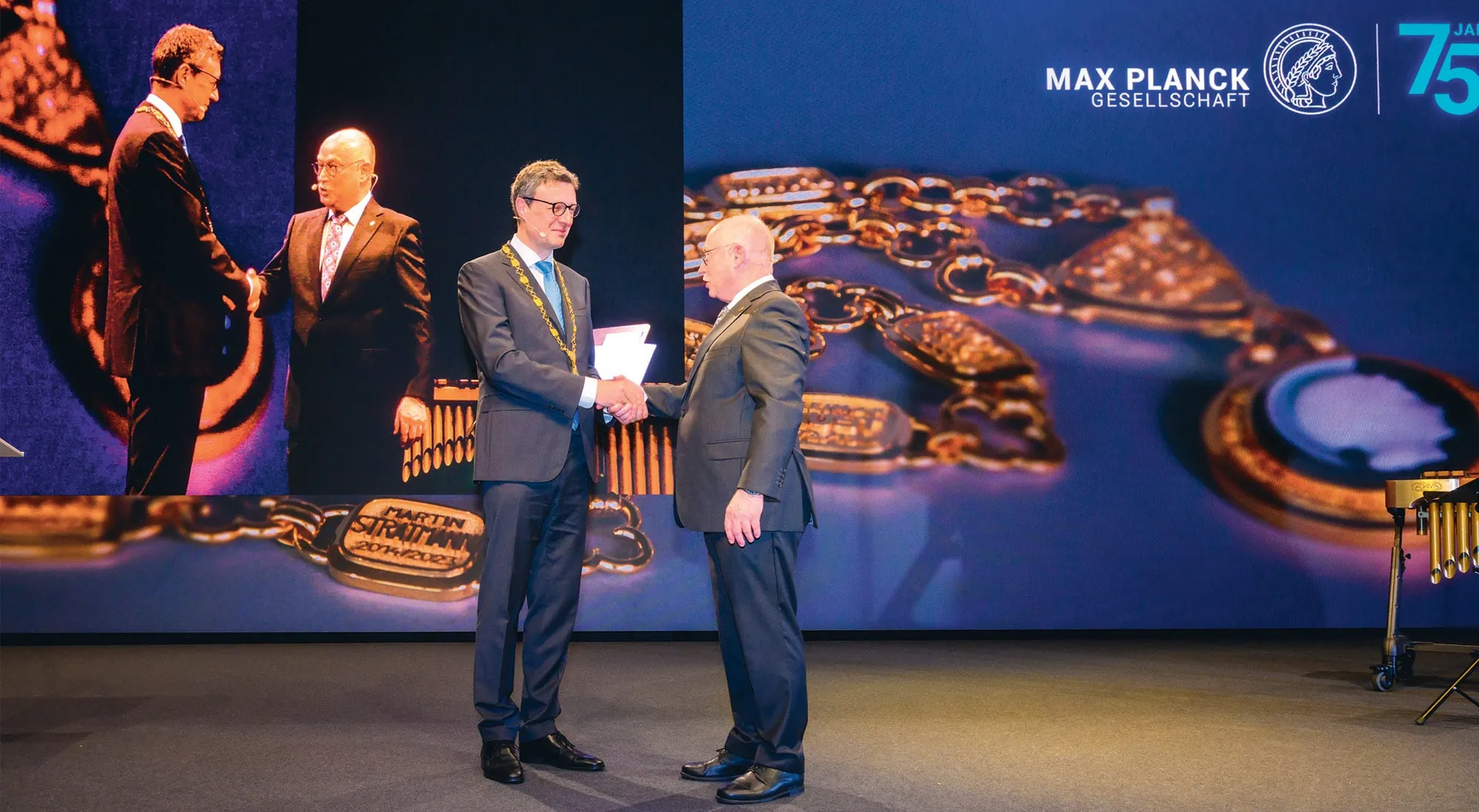
More than 800 internal and external guests attended the Annual Meeting of the Max Planck Society in Göttingen from June 20 to 22, 2023. Prof. Dr. Martin Stratmann received a standing ovation from the audience following this keynote speech, in which he urged both federal and state governments to reduce bureaucracy in order to maintain Germany’s ties with leading scientific nations, such as the USA and China. Stratmann stated, “Those who seek to avoid risks actually take the greatest risk.” Prof. Dr. Patrick Cramer, the newly appointed President of the Max Planck Society, echoed this sentiment in his inaugural address, declaring, “Those who think freely, inspire others, and explore uncharted territories can achieve groundbreaking research outcomes and ultimately change the world.”
The Annual Meeting for this year, held in Göttingen from June 20th to 22nd, commenced on Tuesday evening with a scientific opening lecture delivered by Dr. Melina Schuh, Director at the Max Planck Institute for Multidisciplinary Natural Sciences. The lecture took place in the grand auditorium located at Wilhelmsplatz. Prof. Dr. Martin Stratmann, President of the Max Planck Society, and Prof. Dr. Metin Tolan, President of Georg August University, warmly welcomed the primarily internal attendees and emphasised the strong network and thriving scientific environment present in Göttingen. Vice President Dr. Asifa Akhtar introduced the speaker, highlighting that Dr. Melina Schuh was appointed as one of the youngest directors in 2016 and had already been recognized with the prestigious EMBO Gold Medal as an outstanding young researcher. Akhtar further praised Schuh as an exceptional role model, both as an accomplished scientist and a group leader.
In her captivating lecture “From studies of eggs to fertility treatment”, Dr. Melina Schuh took the audience on a fascinating “journey to the beginning of life,” highlighting the relatively limited research conducted on the human egg cell. She shared her group’s groundbreaking work in recent years, which involved developing various methods to address this knowledge gap. One significant discovery pertains to enhancing the accurate separation of chromosomes by stabilizing the spindle apparatus responsible for this process. Schuh’s presentation included a compelling graph illustrating the importance of considering family planning at a younger age. It demonstrated how the risk of faulty chromosome transmission increases with age, rising from around 20 percent in younger individuals to 70 percent in older individuals. The audience was thoroughly impressed by the lecture and the remarkable outcomes achieved by Schuh and her team, as evidenced by the multitude of questions that followed her presentation.
Medals and awards for young researchers
In 2023, a total of 29 young scientists are being honoured with the Otto Hahn Medal for their exceptional scientific accomplishments in relation to their doctoral theses. The ceremonial presentation of these medals, endowed with 7500 euros each, took place during the Section meetings on the opening day of the 74th Max Planck Annual Meeting in Göttingen.
Four of the awardees, namely Dmitriy Borodin from the Max Planck Institute for Multidisciplinary Sciences, Zhexin Wang from the MPI for Molecular Physiology, Qun Yang from the MPI for Chemical Physics of Solids and Micha Heilbron from the MPI for Psycholinguistics—have additionally been honoured with the Otto Hahn Award. This prestigious award affords them the opportunity to engage in research abroad. Following their research stay, these young scientists have the opportunity to head their own research group with their own research concept at a Max Planck Institute.