



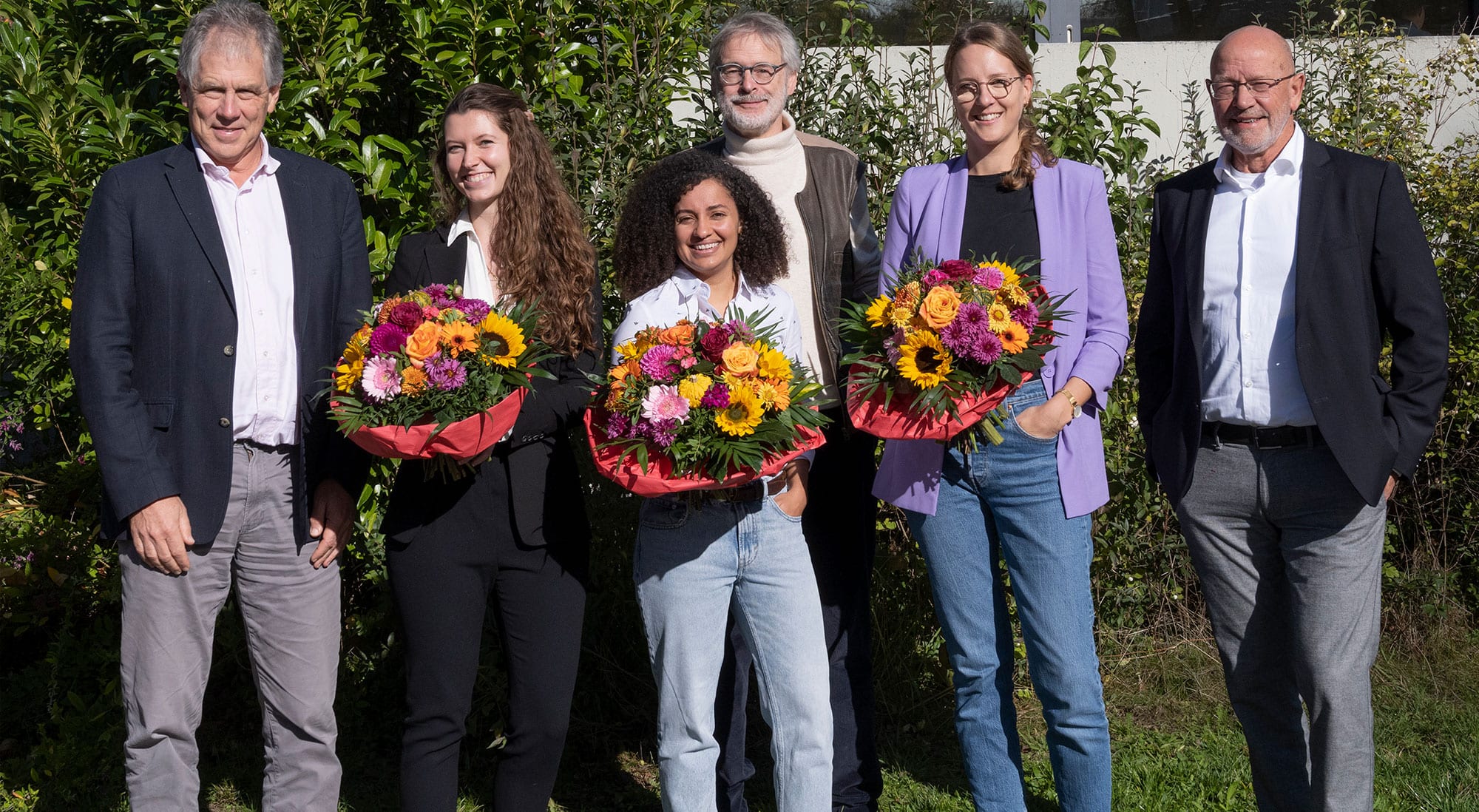
Drei Wissenschaftlerinnen am Max-Planck-Institut für biologische Intelligenz in Martinsried (in Gründung) sind Ende Oktober mit dem Young Scientist Award ausgezeichnet worden. Der mit 1000 Euro dotierte Preis geht an Sandra Reinert für ihre Forschung zu Lernprozessen bei Mäusen, sowie gemeinsam an Renée Vieira und Sandra Fendl für die Entwicklung einer neuen Methode zur Untersuchung von Nervenzellproteinen in der Fruchtfliege. Der Young Scientist Award würdigt die herausragenden Veröffentlichungen, die aus dieser Forschung entstanden sind.
Wie vereinfacht das Gehirn komplexe Informationen"
Kategorisierung ist ein wichtiges Element des Denkens. Das Gehirn nutzt die Methode, um die unzähligen Eindrücke des täglichen Lebens zu organisieren und zu vereinfachen. So können Menschen und Tiere schnell und effektiv auf neue Erlebnisse reagieren. Dem zugrunde liegt ein komplexer Lernprozess, dessen Funktionsweise bislang nur teilweise verstanden wird. Sandra Reinert und ihre Kolleg*innen in der Abteilung von Prof. Dr. Tobias Bonhoeffer erforschen den Prozess des Kategorienlernens an Mäusen. Ihre Arbeiten haben gezeigt, dass auch Mäuse überraschend gut kategorisieren können. Dafür nutzt das Gehirn bestimmte Gruppen von Nervenzellen, die erlernte Kategorien repräsentieren und als abstrakte Informationen abspeichern. Die nun mit dem Young Scientist Award ausgezeichnete Veröffentlichung wurde im April 2021 im Journal Nature publiziert.
Sandra Reinert studierte Biologie an der Ludwig-Maximilians-Universität München und fertigte ihre Doktorarbeit in der Abteilung von Prof. Dr. Tobias Bonhoeffer an, wo sie aktuell als Postdoktorandin forscht.
Wie funktioniert der Informationsaustausch zwischen Nervenzellen"
Ein wichtiger Teil der Kommunikation zwischen Nervenzellen findet über Rezeptorproteine statt. Die Proteine sitzen in der Membranhülle der Zellen, wo sie eintreffende Signale anderer Zellen aufnehmen und an die „eigene“ Zelle weiterleiten. Je nach Rezeptor-Typ und Position bestimmen sie, wie die Zelle auf ankommende Informationen reagiert. Um ein neuronales Netzwerk in seiner Gesamtheit zu verstehen ist es somit unerlässlich, die Rezeptoren und ihre Verteilung in Nervenzellen zu kennen. Für diese Untersuchungen entwickelten Renée Vieira und Sandra Fendl in der Abteilung von Prof. Dr. Alexander Borst eine neue Methode, die mit hoher Genauigkeit die Position von Rezeptorproteinen an der Zelloberfläche sichtbar macht. Die Methode lässt sich auch für andere Proteine nutzen und stellt somit ein neues universelles Werkzeug für die Proteinforschung in der Fruchtfliege dar.
Renée Vieira studierte Biologie and der McMaster University in Hamilton (Kanada) und an der Ludwig-Maximilians-Universität München. Sie ist aktuell Doktorandin in der Abteilung von Prof. Dr. Alexander Borst.
Sandra Fendl studierte Biologie an der Universität Regensburg und an der Ludwig-Maximilians-Universität München und forschte für ihre Doktorarbeit in der Abteilung von Prof. Dr. Alexander Borst. Sie ist zurzeit wissenschaftliche Referentin bei der acatech – Deutsche Akademie der Technikwissenschaften e.V.
Three female scientists at the Max Planck Institute for Biological Intelligence in Martinsried (in foundation) received the Young Scientist Award at the end of October. It goes to Sandra Reinert for her research on learning processes in mice, and jointly to Renée Vieira and Sandra Fendl for developing a new method to study nerve cell proteins in fruit flies. The Young Scientist Award is endowed with 1000 € and recognizes the outstanding publications that resulted from this research.
How does the brain simplify complex information"
Categorization is an important element of our thinking. The brain uses it to organize and simplify the myriad impressions of our daily lives. This enables us to react quickly and effectively to new experiences. Categorization is based on a complex learning process that is still only partially understood. Sandra Reinert and her colleagues in Prof. Dr. Tobias Bonhoeffer’s department are investigating the process of category learning in mice. Their work has shown that mice can categorize surprisingly well. To do this, the brain uses specific groups of neurons that represent learned categories and store them as abstract information. The research paper, which was now recognized with the Young Scientist Award, was published in the journal Nature in April 2021.
Sandra Reinert studied biology at Ludwig-Maximilians-Universität München and completed her doctoral thesis in the department of Prof. Dr. Tobias Bonhoeffer, where she is now a postdoctoral researcher.
How do nerve cells exchange information"
An important part of the communication between nerve cells takes place via receptor proteins. The proteins are located in the membrane surrounding the cells, where they pick up incoming signals from other cells and pass them on to “their” cell. Depending on type and position, the receptors determine how nerve cells respond to incoming information. Thus, to understand the functioning of a neuronal network, it is essential to know which receptors are present and where they are located. Renée Vieira and Sandra Fendl in Prof. Dr. Alexander Borst’s department developed a new method that allows scientists to study nerve cell receptors. The method visualizes with high accuracy the position of receptor proteins on the cell surface. The method can also be used for other proteins and thus represents a new universal tool for protein research in the fruit fly.
Renée Vieira studied biology at McMaster University in Hamilton (Canada) and at Ludwig-Maximilians-Universität München. She is currently a PhD student in the department of Prof. Dr. Alexander Borst.
Sandra Fendl studied biology at Universität Regensburg and at Ludwig-Maximilians-Universität München, and completed her PhD in the department of Prof. Dr. Alexander Borst. She is now a scientific officer at acatech – Deutsche Akademie der Technikwissenschaften e.V..