


IZB one of the largest biotech hubs in Europe
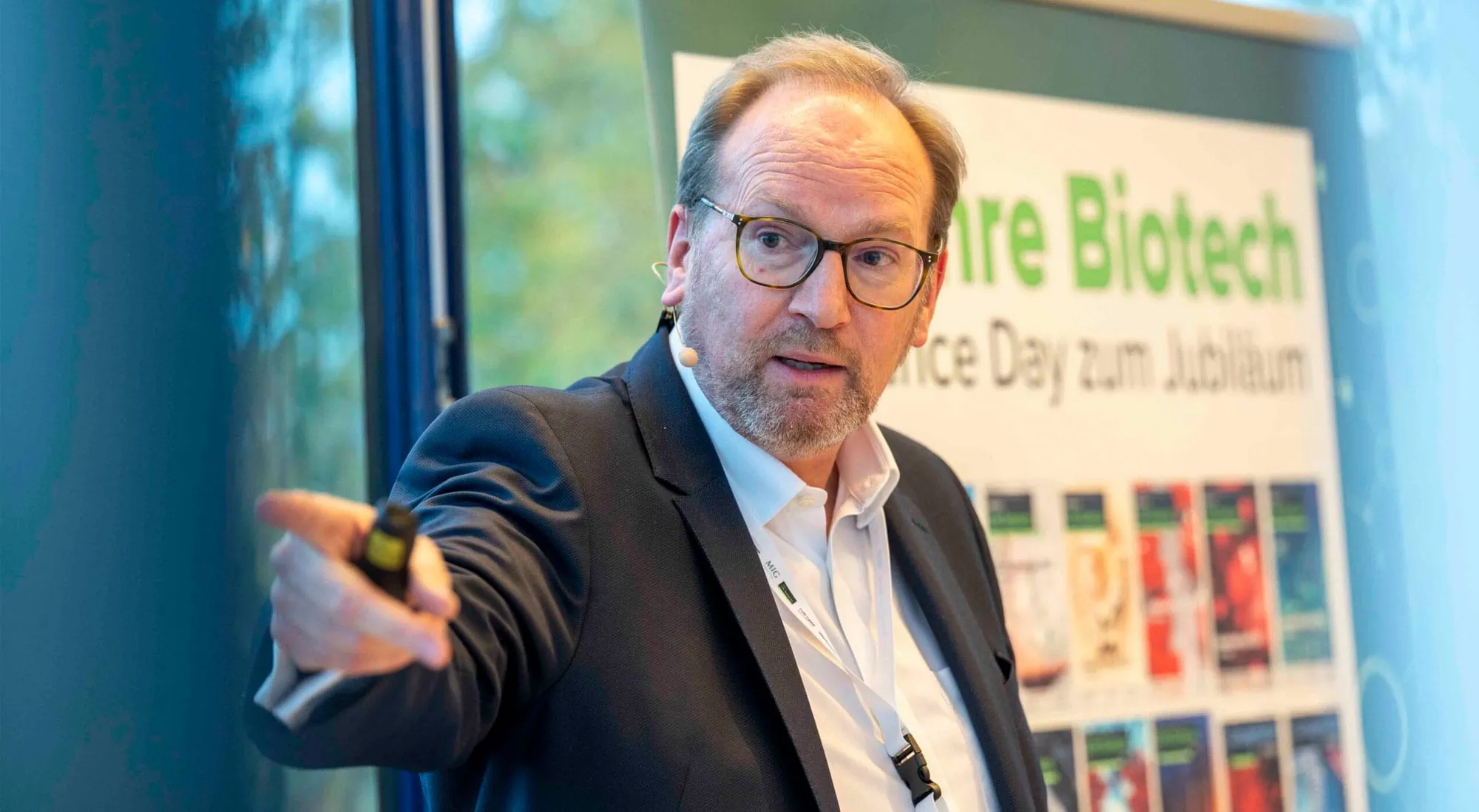
Dr. Peter Hanns Zobel, Managing Director of the Innovation and Start-Up Center for Biotechnology (IZB), welcomed the participants. His conclusion on the last 25 years: „Biotech has changed the world!“ Zobel also looked back on 27 years of biotechnology at the IZB. He said that the claim of being one of the largest biotech hubs in Europe is being lived up to. For example, the companies located at the IZB have closed deals worth at least EUR 5.6 billion since 2015 alone. (Link to the presentation)
IZB one of the largest biotech hubs in Europe
Dr. Peter Hanns Zobel, Managing Director of the Innovation and Start-Up Center for Biotechnology (IZB), welcomed the participants. His conclusion on the last 25 years: “Biotech has changed the world!” Zobel also looked back on 27 years of biotechnology at the IZB. He said that the claim of being one of the largest biotech hubs in Europe is being lived up to. For example, the companies located at the IZB have closed deals worth at least EUR 5.6 billion since 2015 alone. (Link to the presentation)
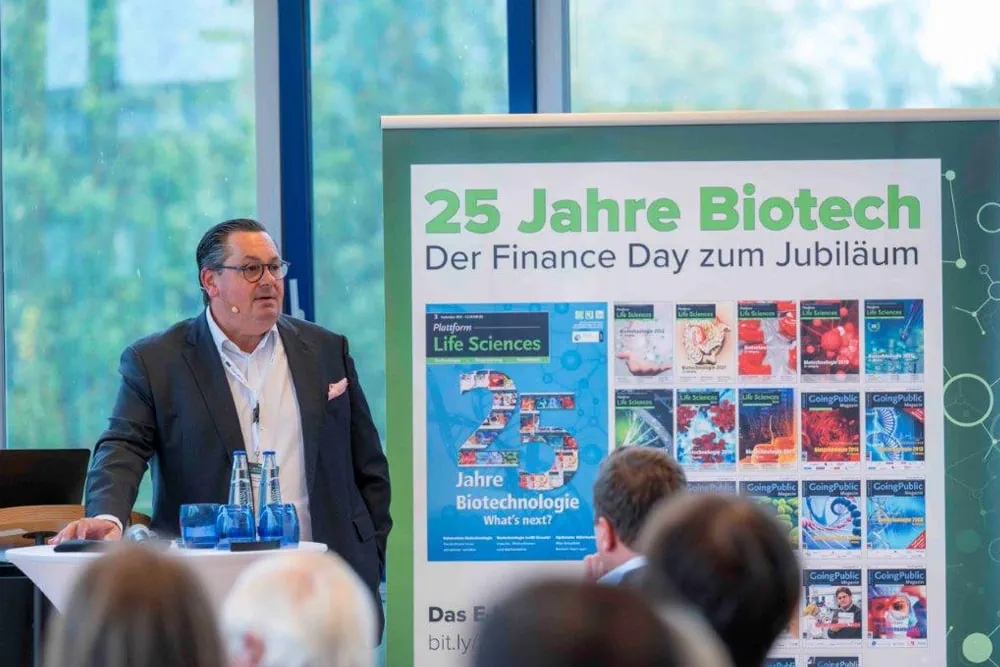
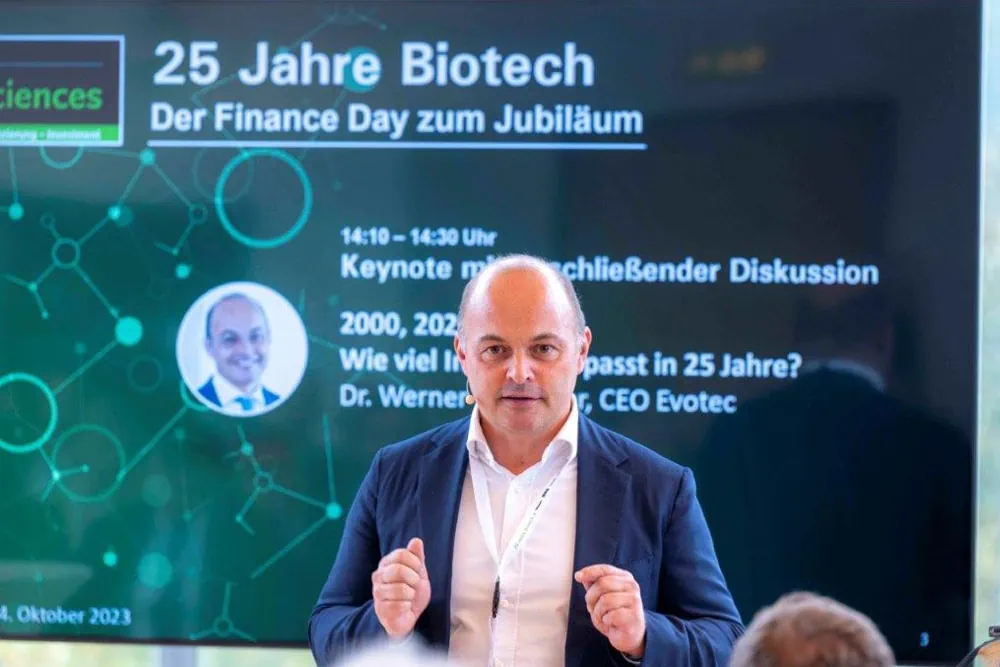
Nevertheless, it is important to persevere and enable further progress so that all people can get access to innovations. To achieve this, it is also necessary to share content in order to provide better access to modern medicine and at the same time reduce development costs. The development of innovations and providing access to them should not be played off against each other. (Link to the presentation)
Venture capital in changing times
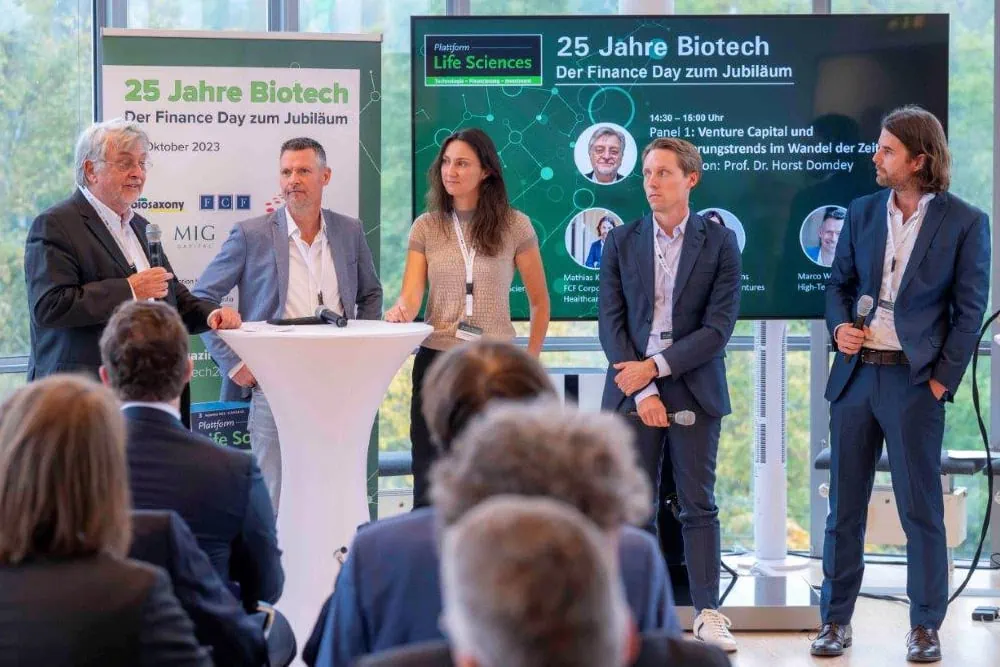
In his panel „Venture Capital and Financing Trends in Changing Times,“ Prof. Dr. Horst Domdey discussed past, present and future questions about financing activity. Domdey looked back, partly critically, partly nostalgically: „In 2000, there were 35 venture capital investors in Munich alone. Where have they gone?“ Dr. Sascha Berger of TVM Capital Life Science referred to the partnerships between investors and pharmaceutical companies. These are a „give and take.“ As an investor, one benefits from the expertise of the pharmaceutical companies (as fund investors) as well as from the lively exchange among experts.
Marco Winzer of High-Tech Gründerfonds underscored the need for constantly evolving financing models. „The standard model has had its day,“ Winzer said. He also referred to changing financing rounds. For example, he said, higher sums are already being spent today as part of initial financing, and increasingly so in consortia, including with the participation of corporate VCs. The installation of evergreen funds is also desirable, he said, to give VC investors more time for their commitments.
Dr. Marianne Mertens from Apollo Health Venture emphasized that venture capital is not a lottery, but an industry with potential and added value. People invest in innovations so that they can stay healthy longer and remain fit into old age. Mathias Klozenbücher of FCF Fuchs Corporate Finance explained that U.S. investors are also increasingly appearing as strategic fund investors in Germany. „U.S. investors are acting as fund-of-fund investors to gain a foothold in Germany.“ Especially larger financing rounds above a Series B would then gladly be led directly by U.S. investors.
Nevertheless, it is important to persevere and enable further progress so that all people can get access to innovations. To achieve this, it is also necessary to share content in order to provide better access to modern medicine and at the same time reduce development costs. The development of innovations and providing access to them should not be played off against each other. (Link to the presentation)
Venture capital in changing times
In his panel “Venture Capital and Financing Trends in Changing Times,” Prof. Dr. Horst Domdey discussed past, present and future questions about financing activity. Domdey looked back, partly critically, partly nostalgically: “In 2000, there were 35 venture capital investors in Munich alone. Where have they gone?” Dr. Sascha Berger of TVM Capital Life Science referred to the partnerships between investors and pharmaceutical companies. These are a “give and take.” As an investor, one benefits from the expertise of the pharmaceutical companies (as fund investors) as well as from the lively exchange among experts.
Marco Winzer of High-Tech Gründerfonds underscored the need for constantly evolving financing models. “The standard model has had its day,” Winzer said. He also referred to changing financing rounds. For example, he said, higher sums are already being spent today as part of initial financing, and increasingly so in consortia, including with the participation of corporate VCs. The installation of evergreen funds is also desirable, he said, to give VC investors more time for their commitments.
Dr. Marianne Mertens from Apollo Health Venture emphasized that venture capital is not a lottery, but an industry with potential and added value. People invest in innovations so that they can stay healthy longer and remain fit into old age. Mathias Klozenbücher of FCF Fuchs Corporate Finance explained that U.S. investors are also increasingly appearing as strategic fund investors in Germany. “U.S. investors are acting as fund-of-fund investors to gain a foothold in Germany.” Especially larger financing rounds above a Series B would then gladly be led directly by U.S. investors.
The stock market route is not suitable for every company
Markus Rieger, GoingPublic Media, gave an overview of „IPOs and stock market listing“ in his panel. Dr. Thomas Taapken of InflaRx emphasized that the current macro factors are particularly difficult for small and medium-sized listed companies. He also said the market is driven by short-term expectations. Finally, U.S.-listed companies are competing with some 750 market peers for capital and investors. Enno Spillner of Formycon emphasized that the stock market is a good means of obtaining fresh money, even in the short term. There are various tools that companies can use, he said. However, he pointed to the different perspectives between Anglo-Saxon and German investors. „Especially in the U.S., investors are still interested in a good equity story,“ Spillner said. Regarding the current situation, Spillner was relaxed: „After the down there will be an up again!“
Ulrich Sommer of WTS Advisory pointed out the challenges associated with an IPO. Not every company is ready for the stock exchange. Above all, compliance with the necessary regulations is underestimated in many places. On the way to an IPO, the involvement of external consultants is indispensable. Professionalization of the company is also necessary beyond pure science, says Sommer.
Decline in M&A activity, but improvement in sight
In his presentation „M&A as a growth driver in healthcare & biotech“, Dr. Heiko Frank of WTS Advisory named the reasons for the current decline in M&A activity as, among others, the increased interest rate level, a crisis-related restraint, too high expectations on the sellers’ side with regard to valuations or the increasing difficulty in financing. But he was optimistic.
M&A remains a growth driver: „The dry powder is there,“ says Frank. He expects an increase in M&A activity for H2 2024. In general, M&A deals in the biotech segment are relatively stable, in contrast to healthtech and medtech, he said. But the need for companies to specifically address their respective investors and present an attractive equity story is increasing, he said – „in English, by the way!“ (Link to presentation)
The stock market route is not suitable for every company
Markus Rieger, GoingPublic Media, gave an overview of “IPOs and stock market listing” in his panel. Dr. Thomas Taapken of InflaRx emphasized that the current macro factors are particularly difficult for small and medium-sized listed companies. He also said the market is driven by short-term expectations. Finally, U.S.-listed companies are competing with some 750 market peers for capital and investors. Enno Spillner of Formycon emphasized that the stock market is a good means of obtaining fresh money, even in the short term. There are various tools that companies can use, he said. However, he pointed to the different perspectives between Anglo-Saxon and German investors. “Especially in the U.S., investors are still interested in a good equity story,” Spillner said. Regarding the current situation, Spillner was relaxed: “After the down there will be an up again!”
Ulrich Sommer of WTS Advisory pointed out the challenges associated with an IPO. Not every company is ready for the stock exchange. Above all, compliance with the necessary regulations is underestimated in many places. On the way to an IPO, the involvement of external consultants is indispensable. Professionalization of the company is also necessary beyond pure science, says Sommer.
Decline in M&A activity, but improvement in sight
In his presentation “M&A as a growth driver in healthcare & biotech”, Dr. Heiko Frank of WTS Advisory named the reasons for the current decline in M&A activity as, among others, the increased interest rate level, a crisis-related restraint, too high expectations on the sellers’ side with regard to valuations or the increasing difficulty in financing. But he was optimistic.
M&A remains a growth driver: “The dry powder is there,” says Frank. He expects an increase in M&A activity for H2 2024. In general, M&A deals in the biotech segment are relatively stable, in contrast to healthtech and medtech, he said. But the need for companies to specifically address their respective investors and present an attractive equity story is increasing, he said – “in English, by the way!” (Link to presentation)
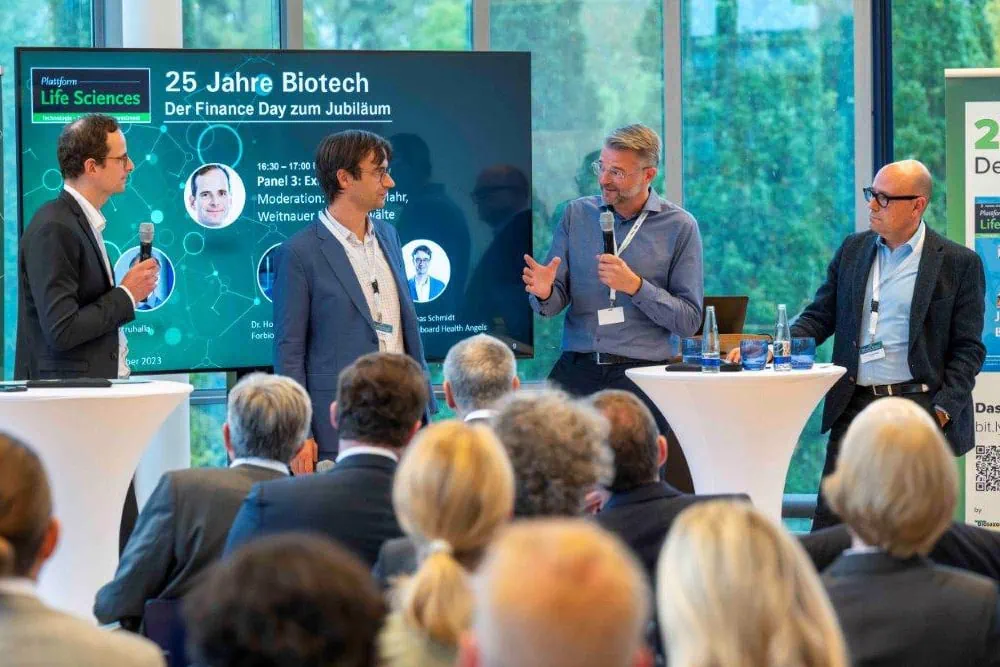
Dr. Marc Struhalla, c-LEcta, described how long-term investors in particular had driven the exit. „We initially followed a dual strategy by approaching both financial and strategic investors.“ Dr. Holger Reitinger of Forbion pointed out that each exit had to be considered individually. Above all, he emphasized, „companies are bought, not sold.“ Above all, he said, the pipeline project should be further developed at the buying company. „That is not a given,“ said Reitinger. Often, the development of the main product candidate is discontinued by the buying company in order to get rid of competition.
Comparison of Germany as a business location
Joachim M. Greuel, Bioscience Valuation BSV, then provided an overview of „Biotechnology locations: a macro perspective.“ In the ensuing discussion, the audience agreed that the U.S. had clear site benefits to offer companies. The country, Greuel said, was convincing with the sheer number of university degrees, company start-ups and the availability of capital. For Germany, some would like to see the subject of „economics“ more firmly anchored in school curricula. (Presentation upon request)
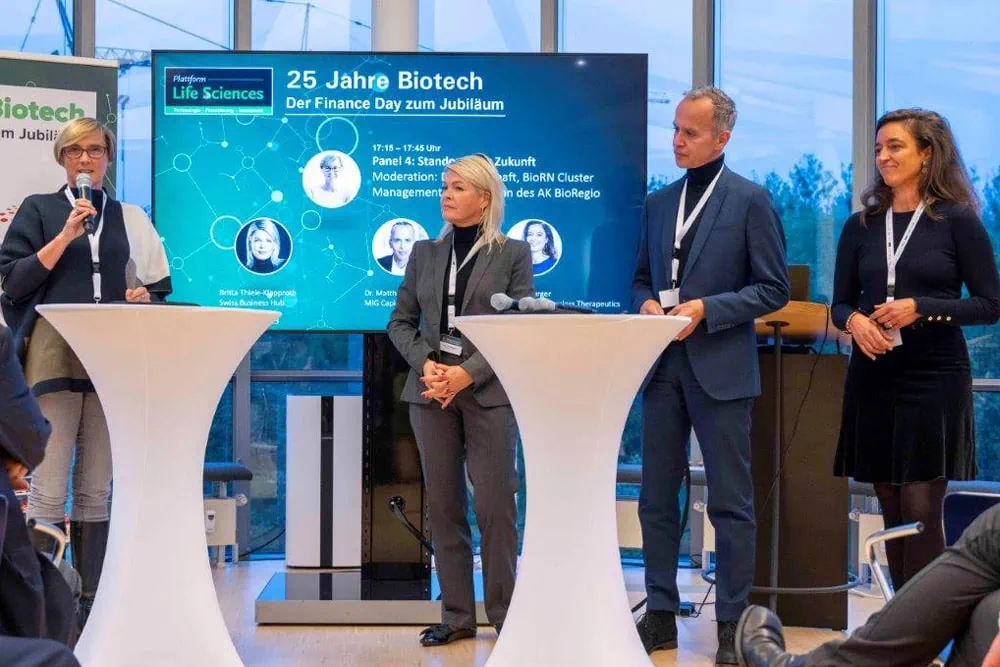
In the last panel, „Locations of the Future,“ moderated by Dr. Julia Schaft from the Cluster BioRN and acting spokesperson of the bioregions working group, she first named important site factors that significantly influence the success of a company, such as the availability of laboratories and suitable premises as well as specialists, but also affordable housing, schools or daycare centers.
Dr. Mathias Kromayer, MIG Capital, said that the business location of a company is not the first priority for an investor. Nevertheless, investors could also contribute to making sites more attractive. Kromayer added that failures are not a question of the business location. However, he said, all players need to ask themselves what they can do to make a location more attractive.
Anne Burger, Catalym und Seamless Therapeutics, raised the issue that many founders would prefer to stay at home or at their university location. The availability of human resources is crucial, she said. Research funding for biotech companies is still too low, she added. And the topic of „employee participation“ is also associated with tax challenges. Britta Thiele-Klapproth of the Swiss Business Hub Germany highlighted the differences between Germany and Switzerland. Switzerland, Thiele-Klapproth said, unlike Germany, does not pursue a national cluster policy. The country is also less regulated and there are fewer collaborative systems: „Switzerland ticks differently!“ The common consensus was to further strengthen strong locations instead of establishing new ones too early.
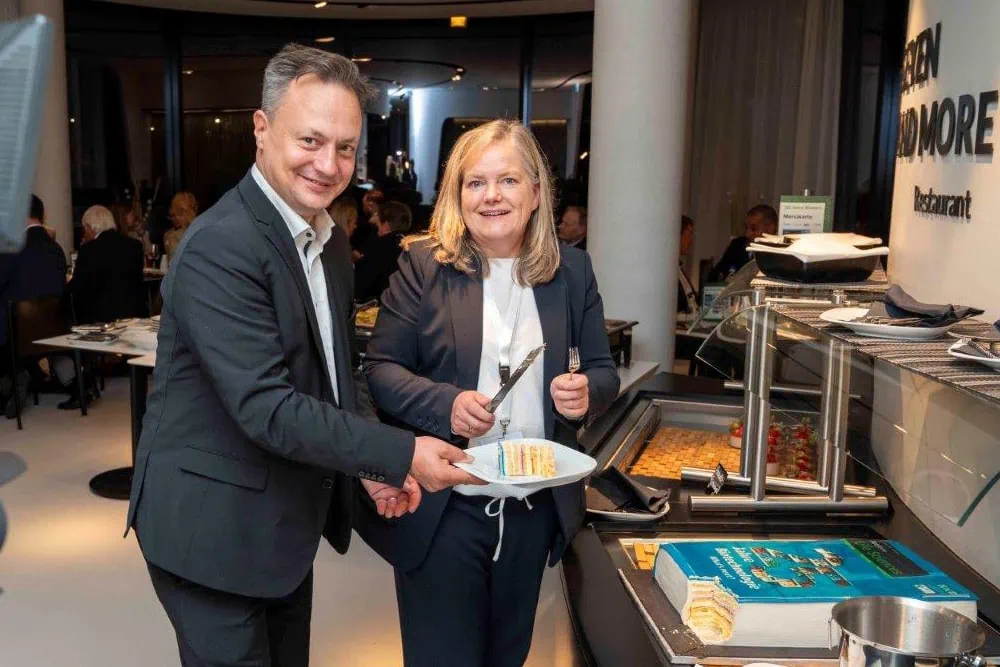
In the evening, networking continued at Campus At Home with an anniversary cake and at the Faculty Club with a get-together at the cocktail bar.
Two more Finance Days are currently being planned for 2024:
Dr. Marc Struhalla, c-LEcta, described how long-term investors in particular had driven the exit. “We initially followed a dual strategy by approaching both financial and strategic investors.” Dr. Holger Reitinger of Forbion pointed out that each exit had to be considered individually. Above all, he emphasized, “companies are bought, not sold.” Above all, he said, the pipeline project should be further developed at the buying company. “That is not a given,” said Reitinger. Often, the development of the main product candidate is discontinued by the buying company in order to get rid of competition.
Comparison of Germany as a business location
Joachim M. Greuel, Bioscience Valuation BSV, then provided an overview of “Biotechnology locations: a macro perspective.” In the ensuing discussion, the audience agreed that the U.S. had clear site benefits to offer companies. The country, Greuel said, was convincing with the sheer number of university degrees, company start-ups and the availability of capital. For Germany, some would like to see the subject of “economics” more firmly anchored in school curricula. (Presentation upon request)
In the last panel, “Locations of the Future,” moderated by Dr. Julia Schaft from the Cluster BioRN and acting spokesperson of the bioregions working group, she first named important site factors that significantly influence the success of a company, such as the availability of laboratories and suitable premises as well as specialists, but also affordable housing, schools or daycare centers.
Dr. Mathias Kromayer, MIG Capital, said that the business location of a company is not the first priority for an investor. Nevertheless, investors could also contribute to making sites more attractive. Kromayer added that failures are not a question of the business location. However, he said, all players need to ask themselves what they can do to make a location more attractive.
Anne Burger, Catalym und Seamless Therapeutics, raised the issue that many founders would prefer to stay at home or at their university location. The availability of human resources is crucial, she said. Research funding for biotech companies is still too low, she added. And the topic of “employee participation” is also associated with tax challenges. Britta Thiele-Klapproth of the Swiss Business Hub Germany highlighted the differences between Germany and Switzerland. Switzerland, Thiele-Klapproth said, unlike Germany, does not pursue a national cluster policy. The country is also less regulated and there are fewer collaborative systems: “Switzerland ticks differently!” The common consensus was to further strengthen strong locations instead of establishing new ones too early.
In the evening, networking continued at Campus At Home with an anniversary cake and at the Faculty Club with a get-together at the cocktail bar.
Two more Finance Days are currently being planned for 2024: