




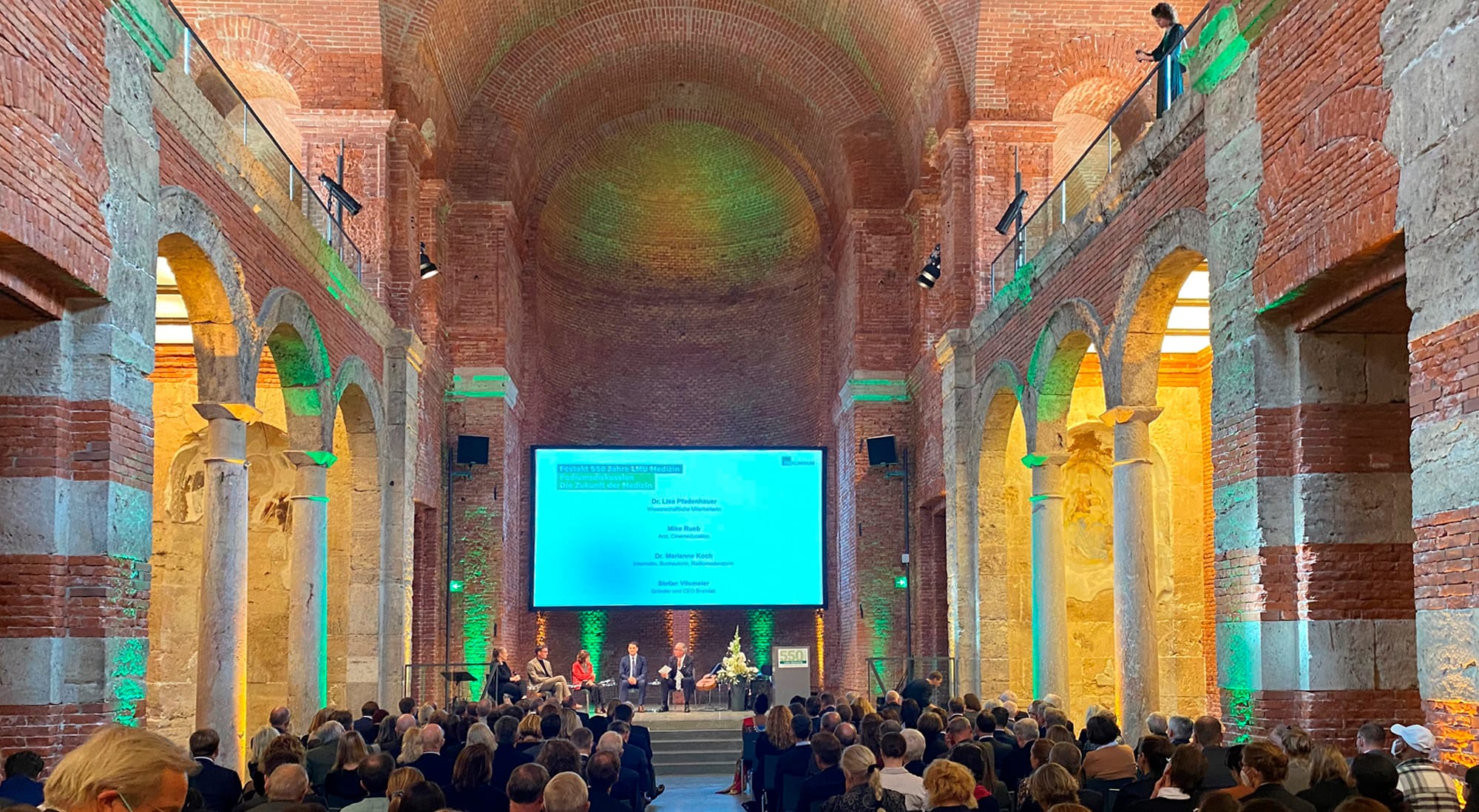
In 1472, it was one of the four founding faculties of the first university in Old Bavaria. Today, the Medical Faculty – as well as the Clinical Center – of the Ludwig Maximilian University are among the largest of their kind in Germany. LMU Medicine celebrated its 550th anniversary on Thursday, October 13, 2022, with a ceremony under the patronage of Bavarian Minister President Dr. Markus Söder. Famous Munich LMU physicians include, for example, the hygienist Max von Pettenkofer, the pediatrician August von Hauner, and the psychiatrist Emil Kraepelin. Important achievements and milestones of LMU medicine include the Dornier kidney stone crusher and Germany’s first heart transplant. An insight into the eventful history and long tradition of LMU Medicine is provided by the commemorative publication “550 Years of LMU Medicine – Excellence since 1472”, which will be published at the ceremony.
During the ceremony, Bavarian Prime Minister Dr. Markus Söder congratulated on 550 years of medicine at Ludwig Maximilian University in Munich: “Congratulations on medical excellence since 1472. We are proud of our university hospitals. They offer the highest level of research, teaching and patient care. With the Hightech Agenda Bavaria, we are promoting innovations in the key technologies of the future. We provide the best medical care throughout the state. My thanks and appreciation: your work makes our lives longer and better.” The Medical Faculty and LMU Hospital are among the largest and best in Germany and Europe, said Prof. Dr. Markus M. Lerch, Medical Director and Chairman of the Board of LMU Hospital, in his welcoming remarks at the ceremony. “We serve the health of our patients, the research of their diseases and the education of our students at the highest international level. The core and soul of LMU Medicine is made up of the team spirit of all professional groups and – for 550 years – the demand for excellence that is lived by all.”
The beginnings of the Munich era of LMU Medicine.
In 1472, the Faculty of Medicine was one of the four founding faculties of the first University of Old Bavaria in Ingolstadt. After a stopover in Landshut from 1800 to 1826, the Ludwig-Maximilians-Universität moved to the state capital of Munich at the instigation of King Ludwig I. The university was founded in 1813. The General Municipal Hospital near Sendlinger Tor – the largest in Bavaria with 600 beds – which had already opened in 1813, now became the university hospital. In 1832, the Sisters of Mercy of St. Vincent de Paul took over nursing care, which they continued to do until the year 2000. In the 19th and early 20th centuries, a number of specialized clinics and institutes were built near Sendlinger Tor, including the Polyclinic, the Surgical Clinic, and the Royal University Women’s Clinic and Midwifery School on Maistraße.
The newly established facilities are often closely associated with well-known medical personalities of the time: in 1846, August von Hauner opened the first children’s clinic in Sonnenstrasse; in 1882, this moved to its present location in Lindwurmstrasse. In 1877, Hugo von Ziemssen founded the first German Clinical Institute; in 1879, the world’s first Hygiene Institute opened under Max von Pettenkofer, and in 1904, the Royal Psychiatric Clinic opened under Emil Kraepelin. In 1903, the LMU became the first faculty in the German Empire to train female physicians; in 1918, Adele Hartmann was the first woman in Germany to habilitate – at the LMU Medical Faculty.
The road to Großhadern
After the horrors of the Nazi era, which also left deep scars on medicine, the campus in the city center soon became too small for the growing number of students, researchers and patients. In 1955, the decision was made to build what was then the most modern university hospital in Europe on the outskirts of the city in Großhadern: Here, all clinics were brought together under one roof in a 60-meter high and 205-meter long ward block. The construction of the Großhadern Hospital took around ten years; the first patient was admitted on September 16, 1974. In 2014, the new surgery center – at the time the largest and most modern surgery center in Europe – was completed in Großhadern. In 1999, the Großhadern and Innenstadt hospitals merged, and from then on LMU Klinikum München continued to develop at both sites. In 2021, the Klinikum Innenstadt opened next to the old General Hospital from 1813 – the so-called Ziemssenklinik. It houses the departments of internal medicine, surgery, obstetrics and the emergency room.
In the area of research and teaching, from the 1970s onward, not only did many medical and life science institutes follow the faculty and the university to the Großhadern campus, but a biotechnology cluster and two Max Planck Institutes also settled in the immediately neighboring Martinsried. The close connection to research is also reflected in patient care. A milestone of more recent times is the kidney stone disintegrator, which LMU physicians developed together with a team from the aircraft manufacturer Dornier and which was used for the first time in 1980. Following Germany’s first heart transplant in 1969 at the downtown hospital, Germany’s first heart-lung transplant was performed in 1983 at the Großhadern Hospital by heart surgeon Prof. Dr. Bruno Reichart. Structurally, too, new paths were taken in Großhadern. One example is the Center for Stroke and Dementia Research, made possible by a foundation, with an outpatient clinic, research laboratories and the headquarters of the German Center for Neurodegenerative Diseases in Munich.